The Relationship Between Fish Growth and Feed Conversion on Aquaculture Farms
Feed conversion ratio describes how much feed is supplied for a given increase in fish biomass over the same period. Growth rate describes the speed of that increase. Although the measures are related, they answer different questions about production, and neither can explain a farm’s performance on its own.
The appeal of high growth rate feed is understandable when production schedules depend on fish reaching a saleable size. Faster growth, however, does not necessarily mean less feed has been used for each kilogram gained. That distinction becomes important when evaluating a feeding programme or comparing the cost of different diets.
What the ratio measures
For an apparent feed conversion ratio, the calculation uses feed supplied rather than a direct measurement of everything the fish swallowed. Uneaten pellets therefore remain part of the input. A worsening result may reflect feeding losses, changes in fish performance or problems with the underlying records.
Biomass is the combined weight of the fish in the production unit. Its estimated increase depends on the starting stock and subsequent measurements, with harvesting, transfers and mortalities accounted for consistently. Small errors in estimated fish numbers or average weight can distort the result, particularly over a short reporting period.
The length of the measurement period matters too. A ratio calculated during a brief spell of poor appetite describes that interval; it does not establish the outcome of a complete production cycle. Comparisons become more informative when they cover equivalent stages and use the same accounting method.
Documentation should state whether feed weights are recorded as supplied or on a dry matter basis, especially when comparing wet feeds.
There is also a difference between feed conversion and the financial cost of growth. A more expensive diet may require less feed for the same gain, but the purchase price must be included before its economic performance can be judged. Multiplying feed cost per kilogram by the conversion ratio provides a basic feed cost per kilogram of biomass gained.
Why growth and conversion can diverge
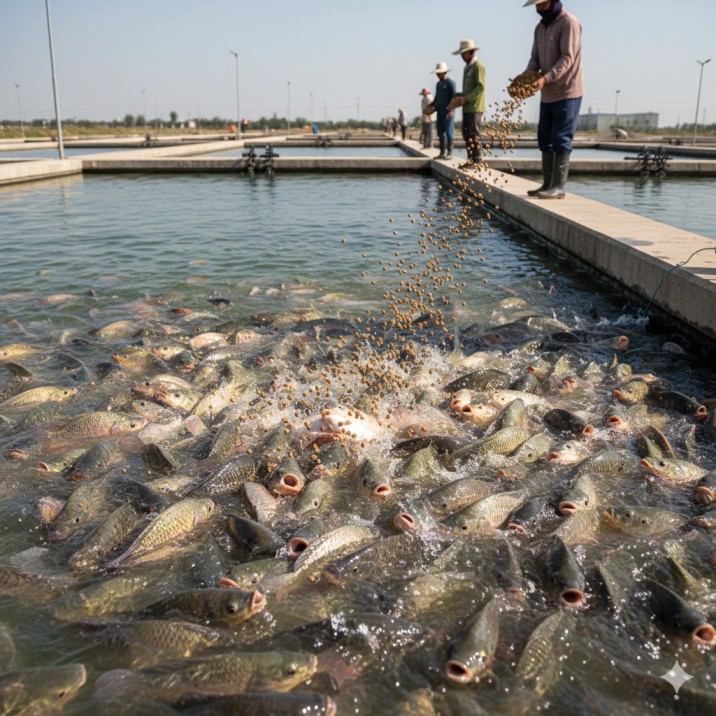
Fish use nutrients for maintenance as well as growth. Water temperature, oxygen availability and health influence feeding and the use of those nutrients. Increasing the quantity offered cannot correct an unsuitable environment, and excess feed can leave the farm paying for material that contributes no gain.
Diet composition and digestibility affect the nutrients available to the fish. Feeding method adds another influence. Distribution, pellet suitability and the opportunity for fish to reach food all affect what happens between a bag being opened and growth being recorded.
These relationships make a simple ranking of feeds unreliable when the surrounding conditions differ. Two farms using the same product may report different outcomes, while a change in farm management can alter results without any change in formulation.
When reviewing a trial, the records need to show when sampling took place and how weights were obtained. Comparable measurements of growth, feed supplied and survival allow the figures to be interpreted together. A sudden improvement following a change in counting or weighing technique deserves investigation before it is attributed to the feed.